Monday, June 28, 2010

Why don't folks stop in Avignon ?

The Figaro daily http://www.lefigaro.fr/conjoncture/  annouced today that France, first world tourist destination by the number of visitors, ranks only third in revenue behind the United States and Spain. "Spain overtook us ten years ago. Ever since are we losing market share, "says Christian Mantei of Atout France, the country's tourism promotion bureau. Last year, these revenues accounted for 36 billion euros, against 39 billion for Spain and 69 billion for the United States. The market share of France in Europe fell from 19.6% in 2000 to 16% in 2009. The British, like the Germans, are less likely to consider coming on holiday in France, focusing on long stays in Spain and Italy."
Apparently they enter France, cross the country at top speed, overnight in a not so cheap roadside inn accomodation and are counted once as visitors, then once again on their way back home.
Well let me tell you - they should stop in Avignon. Not at our place - we are not  keen on overnight stays, due to our lack of organisation - but downtown anyway. Avignon is 20 km south of  the fork were the huge north-south motorway A6 branches towards Spain on the A9 and the Riviera on the A7. Get out of A7 at Avignon Nord, enter the city  after a few Km along the Rhone river, easily park the car (for free in the streets, after six o'clock, or  at any time along the city walls), and spend a night or more into this extraordinary city. You can dine and wine yourselves like a Pope for 14 euros a head. ( The Hermitage restaurant just opened downstairs from our building, but more on this later) Then, after a pleasant night and an early morning stroll in the freshly sprayed  streets, you could buy a postcard,  a bag of lavender, and continue by car if you must towards Spain (  following the Nîmes signs) or Italy ( the Marseilles signs, even in you won't come near it). Maybe I should write to Mr.Mantei, and suggest him to post me on a little chair on that motorway fork,  just to give  info away.

Tuesday, June 22, 2010

An English language bookshop in Avignon

The only English language bookshop in Avignon is located in the eastern part of  the walled-in city. Walk east for about a mile from the Popes's palace along the long and winding Carreterie street, past the derelict-looking church spire of the Augustinians, and you shall reach a lovely bookshop modestly hidden behind a garage type door, painted blue.  It boast a rather large stock of books, both new and secondhand, a good ordering service, and a friendly manager.
Shakespeare Books Avignon was founded in June 1994 by Wolfgang Zuckermann, author of five books and former consultant in Paris and owner of Zuckermann Harpsichords in  New York.
Note  : Mr Zuckerman recently sold his bookshop to a new and young  bookseller ; we wish her the best of success).
Though Shakespeare Books is not officially related to George Whitman's Shakespeare & Co, Paris, Wolfgang Zuckermann 'followed the tradition of English bookshops in France, first started by Sylvia Beach in Paris 1919 with the original Shakespeare & Co'. He is more relaxed and friendly than was his counterpart opposite Notre Dame de Paris. ( I still rememberWhitman's anger when I refused to have my  Penguin copy of  Ulysse defaced by his rather large inkstamp ; nowadays Withman's daughter, named Sylvia in memory of the famous Mrs. Beach, runs the Paris show). Airy and built on a single level , Avignon's Shakespeare seems to offers less opportunity for kissing one's Valentine than the original Parisian maze of books.   There is a tiny garden of sorts at the back, though, and Mr Zuckermann is willing to serve English cream tea and scones in the afternoon. (One might feel he his too much of a delightful character to bother him with menial chores, though.) His place is still redolent of that  nostalgic atmosphere that most English-language bookshops aboard used to have. I'm sure you have visited at least one of those bookshops that seem to be open exclusively for  the benefit of a handful of exiles, or at least, for people definitely not wishing they'd be home, but unable to cut their intellectual ties with the anglo-saxon world. Shakespeare Avignon could be anywhere nice and unexpensive,  in Tangiers, Sienna, Obidos or Kathmandou ; anyplace were people that are not 'travellers' neither  'mass tourists' like to hang out. Follow their steps into that abode of great books, just to check that serious reading is better done under foreign skies. After all, is it not rather more pleasant to immerse oneself resolutely in a novel, if one knows for sure that excitement and novelty are around the corner ? ( photo at bottom  from the bookshop's web site, http://shakespeare.bookshop.free.fr). PS : In the good old days, people were allowed to unroll their sleeping bags in the Paris Shakespeare. Should you need accomodation in Provence, don't forget we have rooms and studios to let in Avignon  .


La librairie Shakespeare (Shakespeare Books) Avignon was founded in June 1994 by Wolfgang Zuckermann, author of five books and former owner of Zuckermann Harpsichords, New York. Though Shakespeare Books is not officially related to George Whitman's Shakespeare & Co, Paris, Wolfgang Zuckermann followed the tradition of English bookshops in France, first started by Sylvia Beach in Paris 1919 with the original Shakespeare & Co.

Sunday, June 20, 2010

Avignon : friendliest city for gays in the south of France

Could it be an heritage from Papal times and so-called “tuscan ways”? Or an influence of the masive influx of actors during the festival ? Avignon is a gay friendly city. Even in winter time, is not uncommon to see same-sex kissing or holding hands, but the summer season brings a party mood to the city.Yesterday the second local gay pride parade was a succes, with a street parade of several  truckloads of dancing gentlemens and ladies - not easily distinguishable from each other. The event was sponsored by  local gay businesses: "La Comédie", a restaurant , "La Scène", a restaurant and bar, "L'Opéra", "Le Cid",  famous cafés on the Place de l’Horloge, "l'Esclave" and "La Cage", two night-clubs and "La Station" – an underwear boutique. Avignon is no Mykonos or Sitges, but seems to act  as a magnet for gays from the more conventional cities around (Nîmes, Orange, etc.). It is also a travel destination for gays from the north of Europe. Did we ever mention it is a very romantic city ?

Sunday, May 23, 2010

10 things NOT to do in Provence

Just for fun , and  inspired  by the web site concierge .com famous do's and dont's, we compiled a list of ten dont’s – and what to do instead, in a region that the shrinked euro makes affordable again.

1-Wear hiking shoes in the streets.
 Look  : you are visiting towns and villages that have streets since Roman times.  By now their pavement is perfectly smooth and your heavy walking shoes will feel out of place. Instead, bring your best office shoes with you : In France, a person status is very much determined by what he/she wears on its feet. And nice shoes might help you resist the temptation of bermuda shorts, flowered shirts and tank-tops.

2-Splurge on a three star restaurant
Yes,they are great, but also mightily over-priced : why pay New York prices for decent french food when  you are in France ? Instead, ask around for nice places.  With a good guide and more importantly advices   from your hotels, the local shopkeepers, you can have a  great lunch or dinner at french prices. And save the money for an other trip.

3- Stand in line to visit Avignon’s bridge.
 First, you wont even reach the opposite  bank ! The far end of St Benezet bridge has been destroyed several centuries ago by the Rhone river and the mighty mistral wind. But althought a lovely sight, it is ridiculously over priced, simply because the  town wants to make most of its reputation. Instead, take the free shuttle boat across to river to green Barthelasse island  and you will enjoy a view identical from the photograph above. Do not forget to visit the Palace of the Popes even if it seems pricey, and the Pont du Gard, a huge roman aqueduct 25 Km west of the city.

4-Taxe taxis around
They’ll cost you  “ la peau des fesses”   your  bottom’s skin. Avoid also  the tourist trains slow and prone to get stuck in traffic. ( Not always so slow  : one of them recently overturned in Marseilles due to an excessive speed). Instead, enjoy public transportation on the fine network of subsidized buses, both inter cities and inner cities , or on 'velopop' the pay-per-ride bike lending system in Avignon


5-Keep a large bottle of mineral water in your bag
 Again, this is a civilized country. No need of toting your personal water reserve as  a trekker in Betchuanaland. And the climate, though sunny, doesn't make our place a subtropical country. (Provence is at the latitude of Maine or Oregon). Instead , enter a café at any time of day.  Drink at the counter.  A glass of water is free, by tradition  ; should you want a free pee-pee also, you might be definitely pushing your luck with the bartender. Order something, anything. The cheapest drink in a french bistrot is a lemonade, enjoy it with mint  or  grenadine  syrup : it  will often be cheaper than  a can of soda at a vending machine or in a convenience store !

6-Book in a Hotel Chain
They are made for visiting businessmen and often tucked in industrial outskirts miles from anything interesting. Instead,  book in a small city hotel or a flat or  guest room rented by one of the locals. You won't be bothered by the whirr of the central air conditionning, and you’ll be more likely to hear the cicadas ... Have you visited our  august 2009 post about the flats we rent ?

7-Buy yourself a vineyard
Côtes du Rhone is the word here. And also Côte du Ventoux,  Coteaux d’Aix. Lovely landscape. Small exploitations.  Some people dream to make  a life style of it. And  are ready to sell everything aat home to buy the whole gammut, a few acres of land, a house with plane-trees and cellars. Talk about a million dollars. It is a sure  way to ruin if are not willing to toil for selling the stuff. Forget quiet evenings watching the wine leaves changing colors, sitting on a stone bench under the plane tree. Over-production of cheap and intermediate wines is such that several dis-illusioned investors are putting back their dream for sale. Instead, if you are in love with wine, visit the specialized shops : I recommend  Avitus, a cave and wine bar, and of course l’Hermitage, soon to open downstairs from our building.


8- Try to park in downtown Marseilles
The streets around the Vieux Port are as congested as Chicago, and your lovely Mercedes or Peugeot  brand new and shining from the Avis stables will be at great risk of being hijacked or burglarized. If I was a good guy, I’d tell you were is the one free parking lot downtown ( tip : in the backyard of a  no frills supermarket.) But then Marseilles was not meant for good guys. Reading the news, it apparently still is the nations capital of  organized crime, keeping loose links with politics and unions. Thank God, the organization itself appear far from perfect, so the ambience is relaxed.  Marseilles is a great city for a day tour. Instead, go by train, keep your sun glasses on at all times, like the local boys do, and fancy yourself  as a deputy of Al Pacino coming to settle a few scores with the Corsicans.

9 –  Gape at  real estate agents windows.
Locals feel  that the price of real estate has been pushed up tremendously by the influx of foreigners. It is probably  depressing to see tourist gaping in clusters at wide-angled-photographs over hiked up prices in agents’s shop windows  - just like kids in front of an icecream parlour.( The Real estate  market has long been depressed in France, and moves slowly.) Plus, figure that the old Madame Escartefigue, willing after all to sell one of her lovely village house, is not keen at all of seing its intentions advertised in front of the neighbours she despizes since about 1955. Instead, should you want to invest, do it quietly, from your armchair, on a computer, and start using first the four big real estate agency networks : Orpi, Fnaim, Laforet, Guy Hoquet.

10 – Pity the bulls in Arles or  Nîmes.
In western Provence and the Languedoc, the corrida de toros is taken seriously.  A month ago, the web site for Arles Easter feria was  hijacked  and defaced by anti-corrida  hackers : they published across the homepage a sentence by Mahatma Gandhi saying that a one could evaluate  a civilisation’s greatness by the  death it  bestowed on its animals, and a few gruesome photographs. Instead of voicing your love for animals ovr a glass of pastis, consider the wisdom words of the Mahatma : the barbarian but noble death of the toro, admired and respected by thousands of people united in  a spiritual fervour at the arena, is much more civilized than at  the slaughterhouse.

Saturday, May 15, 2010

Dutch and British sailors jailed in Provence

Tarascon's royal castle is a massive dungeon, built in white stone for the Good King Rene,  count of Anjou and king of Provence right on the banks of the Rhone river, just outside the city walls. Among the curiosities  of the building, in a remarkable state of conservation, are the graffitis of erstwhile prisonners, many of them with english-sounding names.The place served as a Naval prison, safely located 30 miles inland : piracy was whitesperad on the lower Rhone, and British crews have been detained in the fortress as late as 1815.

On Saturday, June 26 2010, a reconstitution of the naval conflicts of the era  will be held under the castle walls, during the traditional ' Fete de la Tarasque'complete with boats, guns fireworks, 200 locals in costumes. This will largely beat the retransmission of Fifa World cup matches, in my opinion. Even if you miss the party, this place is a must-see of every voyage in Provence, with a lovely reconstitution of medicinal and aromatic garden in one of the courtyards. Tarascon Itself, half an hour from Avignon, is  a maze of cobbled streets leading to old chapels, museums, the Soleiado  manufacture of fabrics, and good priced restaurants ( I recommend the Brasserie du Palais, were Bernard and Charles speak english, for breakfasts and lunch.).
Tarascon is an interesting site, where the Rhone river flows at its mightiest, just before entering his delta know as the Camargue.  It is a major crossroad for rail, linking Italy, Spain and northern Europe, and was heavily bombed before the allied  forces landing operations in Provence in 1944 : last year's fete de la tarasque was devoted to a reconstitution of the  Allied landing near Saint Tropez.

Thursday, May 13, 2010

Visit French Listed Historic Monument N°2

When Prosper Merimee,  learned and fashionable writer of the 19th century drawed his famous list of remarkable French monuments, around 1840, item number One was Mount Saint Michel in Normandy. That extraordinary  pyramid of stone defying both the tides and the English certainly deserved the honour of being listed in the inventory that later directly inspired the French National Heritage listing.  (No surprise, because Merimee became Inspector of Historic Monuments.)
 But then, what was item number Two on the writer's list ? Not Versailles, neither Notre-Dame de Paris. No Amiens, no Vezelay or Chenonceaux. Not even the Palace of the Popes. But  a rather humble stone chapel,  Saint Gabriel, at the western foot of the Alpilles, 20 km from Avignon in the  Tarascon Municipal limits.
Saint Gabriel, built in the XII century  is one of the very few chapels in this country to be dedicated to an Angel, not a Saint ; it is also a fascinating  edifice  mixing  splendid sculpture on the main  facade over the door with absolute sobriety inside. The location is gorgeous. Something quite peculiar definitely radiates from the site. Peace. Inspiration. Sacred breeze in the pine trees. Absolutely not trinquets sellers or soda-vending stalls.
Our suggestion for a memorable day: You can easily walk from Saint Remy ( 20 mn by public transport from Avignon's gare routiere, located 5 minutes from home)  to Saint Gabriel, in about four hours, along a lovely and partly shaded footpath. Then  enjoy the place at length,  briefly regret the absence of  the soda vending stalls, and then walk to the next crossroad and  take a bus back to Avignon, Tarascon... or even Arles where you can have lunch or dinner and then bus back to Avignon. We can check the bus times for you, lend you  maps and directions.
Olivia and I are so impressed by this site, discreet but very dear to the heart of the local population, that we decided to call our first son Gabriel.

Sunday, May 09, 2010

Avignon : Brand new beds in a gothic home.

There are some brand new beds in the one-bedroom flat available for rent this season. yet something in the adjacent wall  of the master bedroom may surprise you. You will notice the presence of various cabalistic symbols on the stones, called " peiro signado" in  provencal :  forget about Nostradamus and  Da Vinci code, these are the marks of the Companions, or  stone cutters. They were paid by the stone, and so identification of their work was essential. This custom predates the fourteenth century, and the installation of the popes in Avignon. When staying in our city, make sure you  live not only in the inner city walls, but in the ancient  gothic-era center, wonderfully restored. and where you will find all the museums  and action.. (this central area is in  located in a small crcle of streets , on the south the rue des lices, the west rue vernet, the east  rue sain,  and on the north the  Rhone river and the palace of the Popes itself..

Sunday, April 25, 2010

Volcanic cloud makes for quiet streets in Avignon

Quieter-than-usual spring season in Avignon : the no-fly zone extended over Europe, and more importantly, the long TGV (superfast trains linking the city to Paris and beyond London and Amsterdam) strike, all but isolated Avignon last week.
 I could not resist  publising this 1947 Times article, from the 1947 April 14 issue, Atlantic Oversea edition,  page 24, found in an old copy sold for 20 centimes at a  " Brocante" ( second-hand goods market) today, in Bonpas, near Avignon. Isn't it beautiful  in its sobriety and precision? Seems that nowadays the main danger from  eruptions is the information  flood...
Not all airports where closed, and I fetched my wife last week from Lyons' St Exupery airport, very convenient. Makes sense to rent a car there and watch the vegetation go greener the more you travel south down the Rhone Valley - if you have a flight from this small but cosy airline hub. Two hours by expressway, or you could stop en route in places like Pont St Esprit ( for the ancient bridge), or Grignan (for the castle)...

Monday, April 19, 2010

Cubicula locanda

That's latin for " Rooms to let".  I don't now how that title will rate with the search engines such as google or yahoo, but indeed we have nice rooms to let in the city of the Popes, a mediaeval wonder in the midst of Provence. If you comme at all to Avignon, you should stay right in the gothic-era city center of this former world capital.  You will undoubtely enjoy the visit of the Pope's palace, but also the walks in the pedestrian shopping area nearby,  the museums, churches, restaurants, open-air markets...

We have at home a small english language library from which you  will be welcome to borrow. (Links between Avignon and english-speaking writers as diverse as Henry Rider Haggard ( Remember the Red Eve and Murgh the Messenger ?),  Lawrence Durrell - the Quintette d’Avignon ... are numerous and often amusing. ) There is also a friendly english bookshop on rue Carreterie, not far from our place, which doubles up as a tea-romm most afternoons.

 Below are a few photographs of the  second floor rooms and the first floor studio with mezzanine...  (a work in progress, will be ready by end of April ...) designed to accomodate four people under a spectacular beamed ceiling.  Contact us  for bookings  : catamaran@ymail.com and please note that we are already fully booked in july.

Wednesday, March 24, 2010

Lady Ashton, EC foreign affairs supremo, to study French near Avignon

Le Figaro " story of the day" is a front page feature in the influential Paris daily.  This morning, Baroness Ashton was quoted as answering to an angry French cabinet minister that yes, she needed to improve her French ; and that she was to spend this summer a week near Avignon in a language school.
The school  she elected  is apparently "Millefeuille", which offers residential French language courses for adults, and an opportunity to "study and practise French 50 hours per week and more…", with a friendly native team of teachers, while staying in the elegant premises of Chateau Correnson. Their website http://www.millefeuille-provence.com also provides links to a free langage level test, and a basic on-line course in french.
Le Figaro went on to regret that the minister's remark was likely to reinforce  the image of France as an arrogant  country prone to teach unwanted lessons to others. Let's hope the prestigious student will have time to escape to Avignon, and see by herself that nowadays you don't need to be a langage specialist with top diplomatic abilities to fully enjoy a visit in Avignon and Provence. ( photo : the gates of the " Petit palais" in Avignon.)

Sunday, March 07, 2010

"Village in the Vaucluse", a Harvard man in Provence

Laurence Wylie,  eminent teacher for whom a chair was created in Harvard, spend a year in Luberon with his wife and young kids. He didn't stay in a million-euro mas with a pool and a couple of 4WDs, bought on a huge consultant's or lawyer's salary, but during a sabbatical, on a small university grant, in an icily-cold rented village house. It all happened sixty years ago, and the Wilies didn't even own a car. Instead, they seem to have made a great number of friends. After a while, even the communist villagers agreed Laurence  was not a spy busily preparing an American invasion in case France went Red.
Born 1909, the friendly American actually was an anthropologist specializing in the study of French culture and civilization. In his book he draws a very warm, and at times quite witty, account of life in the early fifties in this remote Provencal village he calls 'Peyrane' - actually Roussillon, 40 km from Avignon, between Gordes and Apt.
His fascinating work  'depicts the villagers within the framework of a systematic description of their culture and way of life' (Harvard University press blurb). The book was translated in French during the sixties,  but is, somewhat remarkably, not very popular in France, maybe because the author chooses  not to focus his incisive, jargon-free analysis on parent relations, symbolic expressions, language, religious beliefs and mythologies. Instead, he affectionately and precisely describes things as exotic as  'securité sociale', bowling manners, etc, and also  what the French call " une société bloquée",  a stuck-up society, where jealousy, even hatred impregnate most interpersonal relations, to a degree which for instance effectively prevents the village as a whole to get  a new school building, or young tenants to move in unoccupied houses. The owners had rather the roofs removed.  Poverty was widespread, even the well-off were living in extreme simplicity. Post-card pretty as it may look in the author's B&W photographs,'Peyrane' in the fifties was a hell to live in. But a hell where everybody knew everybody.
 Sixty years after the Wylie's sabbatical in Roussillon, Provence has become a world favorite destination and Vaucluse " golden triangle" a favorite holiday  haunt of the ruling French elite, with a good deal of rich Americans sprinkled over. 
The unconfortable house rented in 1950 by the anthropologist and his wife - which they could have bought for $3000 - was sold to a sculptor, then to world famous novelist Jean Lacouture. It was valued well over a million dollars in 1987 when Wylie wrote a postscript to his study, noting that the village was invaded by tourists on the watch for celebrities,  but hmself failing to recognize most of his former friends. By this time the 'community' that once was 'Peyrane', with its bitter interpersonal feuds and wonderful sense of beign a united village, had all ceased to exist.


The POSTFACE was published in Wylie L., 1988, « Roussillon, un village dans le Vaucluse, 1987 », Terrain, n° 11, pp. 29-50.

Thursday, February 25, 2010

A Public Library fit for the Name of the Rose

ceccano library avignon

The Ceccano Municipal Library is housed in a huge, unassailable, pale limestone palace, the only gothic residential structure in Avignon which does not pale in comparison with the Palace of the Popes. This formidable dungeon built during the papacy of Benedict XII actually predates the famous Palace ; it was the "livrée" of cardinal Annibale de Ceccano. It holds about 50000 books, 7000 manuscripts, and 60000 prints and drawings. It is indeed a pleasure to wander through the bookselves under the painted rafters of the ceremonial rooms, or to rest on a stone bench by an antique window, holding a copy of Edwin Mullins' "Avignon of the Popes", wich brings to life the history of the city.
But it is thanks to an other author, David Lodge, (in The Year of Henry James) that I became aware again that Umberto Eco's famous bestseller of the eighties, "The name of the Rose" was staged right in the period when the popes where exiled in Avignon, then dubbed the 'Altera Roma'.

Remember the moving letter of dying Prior Adso ? Umberto Eco concluded this epistle and his palpitating and erudite crime novel with the famous verse :
STAT ROSA PRISTINE NOMINE, NOMINA NUDA TENEMUS
Only the name of the early Rose remains, nude names only are left to us

Mr. Lodge says, along with many scholars, that the'Rosa' so mysterious in the book as well as in the famous verse might have stood for 'Roma' due to a copying error. But here I beg to dissent : indeed in Avignon the museum holds a precious gold and jewel rose, wich was bestowed by the popes to their most grand and faithfull supporters visiting the Holy See in Avignon.
Umberto Eco's novel explicitly refers to the visit of Michael of Cesena in the benedictine abbey, while en route to Avignon, in the winter of 1321 under the papacy of John XXII, Benedict XII predecessor. So maybe this was the key of the power struggle in the abbey : they all wanted to please the pope and get a pretty "Souvenir d'Avignon" just like modern-day visitors.

Note : The mediatheque is about 100 meters from our studios and flats, the weather is now so warm that you dont't even need to put a jacket on to go there and to verify my ( precarious) theory by digging in its numerous books and manuscripts. Entrance is free, membership cards for borrowing books and CD's cost 9 Euros for Avignonnais and 20, for less happy mortals.

Saturday, February 20, 2010

Avignon during the festival

During the July Theater Festival Avignon is a different sort of place. People say this is the worlds biggest theater festival, and it might well be true. But most importantly, this extraordinary time of the year gives the city a unique, youthfull atmosphere that lingers on for many months. Actualy there are two festivals at the same time : Rather like on Broadway, there is a "In" festival in the Pope's palace and a few other grand venues, for big officila productions, and an " Off" festival for smaller, independent compagnies, one-man shows, performances, etc.


The Off boasts 250.000 spectators, 800 theater companies, a thousand shows in a hundred different venues.
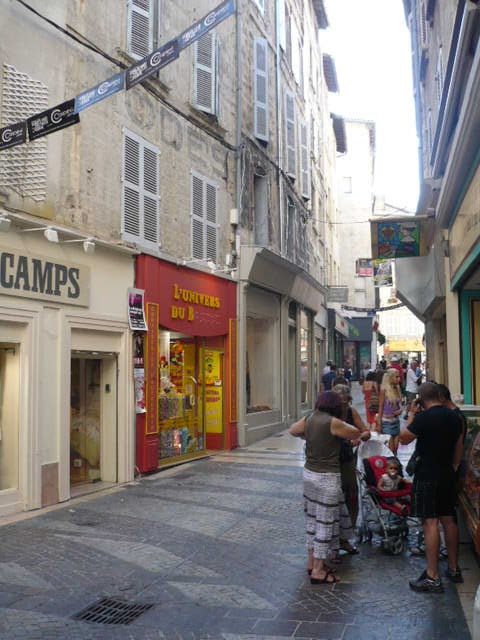
Here are a few photographs of the streets of Avignon last July, adorned with the billboards that advertise the shows. Even the most blasé of the Popes'city denizens love that period. Actors in costumes throng the streets, al fresco dining is the rule. Nights are hot and short. It is more than a cultural event : an experience, gathering artists and audiences from all around the world.
Every year, the festival welcomes artists and performers from many countries and many languages will be heard on the stages : French as well as English, Spanish, Italian, Arabic, Polish, German and Hebrew.

Accomodation at this time of the year will be a bit tricky to find. Prices of our studios and rooms must be discussed and booked well in advance.

Friday, February 05, 2010

This man is not Buffalo Bill Cody !


He is Frederic Mistral, the father of the "felibre" movement of writers, publishers and poets, based in Avignon and which revived the provencal language in the second half of the nineteen century .
One of his most notable followers, the Marquess Folco de Baroncelli-Javon, took a lasting fancy for the american hero and it's Wild West Show.
In a fascinating book : " Cock and Bull Stories: Folco de Baroncelli and the Invention of the Camargue", (univ of Nebraska) Robert Zaretsky links the most respected poet of Provence with Buffalo Bill, Sioux Indians, and the horse-mounted gardians, the cowboys of Camargue. The Cock is the Gallic symbol of France, and the Bull stands for southern France with its deeply different history and culture. Langage and economic issues of the domination by the northern " francimans" of the southern " povre merjonaux" are dealt with in this ingenious book which adopts a thesis little in vogue with french researchers, whose careers depends of the reveration of a French Republic united around ideals professed by the Paris media.
Folco de Baroncelli, a local aristocrat who married into wine, failed to be the follower of Mistral. A relatively mediocre writer, he was deeply moved by the fate of the Oglala Sioux, a Native American people, reinvented the history of Camargue, the Rhone delta region, rich in wild horses, bulls, pink flamingoes and mosquitoes. Galvanized by the example set by Buffalo Bill Cody, Baroncelli did recast the Camargue as 'le far-ouest' of France. The fun, and little know part of the story is that he himself created from scratch the 'immemorial' traditions he battled to protect. The costume, ceremonial, mythic origins, in fact the whole concept of " nacioun guardiano", developped in a few years and later endorsed by politicians and tour-operators alike, is entirely his doing. Creating one of the last myth of his country didn't bring him much money, though : Having sold his palace in the heart of Avignon, his wife's wine estates, he retired in Camargue and died in 1942 in Avignon when the civilan population delta was evacuated by the Germans in the preparation of the american landing in Provence.

Wednesday, February 03, 2010

Winter in the hills of Provence

Avignon is surrounded by hills. Tiny mountains, like les Alpilles, which tend to keep snow longer than the plains. Here are a few photographs of les Baux de Provence, a somewhat overtouristed place in the summer, but which seems to have reverted to its pre-war state of quiet abandon.
The sky is often incredibly blue, road conditions are back to normal, the temperature is at least five degrees warmer than in Paris, and in my opinion it's altogether a great time of the year to come to Provence, ans see light again. " Post Tenebrae Lux" as man wrote on the old lintel of this ruined renaissance window of les Baux.

Monday, February 01, 2010

From Venasque to Gordes

Both these cities, some 25 kilometers from Avignon, are " villages perchés", fortress-like heaps of house cluttered on a hill top and down its rapid slopes ; Gordes is world famous, of course, one of the prettiest villages in Luberon ; but Venasque, facing Mount Ventoux, and adorned with a very ancient church is quite interesting.
The road between them passes by the cistercian Abbey of Senanque, and some wonderful scenery, ( through wich it was not incommon to be attacked by brigands until late in the nineteen century). Read french author Jean Giono for the details.
The beehive-shaped houses are called bories, a whole village of these can be visited near Gordes. Guess what ? they even have a real estate value.

Saturday, January 09, 2010

Record-breaking snow in Avignon


Friday night was unusually cold and quiet. Yesterday, Avignon woke up under a thick, frozen blanket of snow. A rare event in the city of the Popes, noted for its dry climate. Kids were playing - some of them even skiing- on the sloped Place du palais des Papes. The snow was so heavy that it broke some tree branches. The inner-city streets are still covered with it after 24 hours ; no municipal service can effectively enter this maze of frozen lanes. But shops are still open : those are the first days of " les soldes de janvier", boxing day sales, and customers are not deterred by the snow. Certainly not my wife...

Monday, January 04, 2010

A five-star Marriot hotel in Avignon

An austere looking XIX century building with a superb location, just north of the Popes Palace and Rocher des Doms once was the infamous Saint Anne jail. Locals remember the time when the neighbourhood was resounding of the shouts of prisonners over the wall chatting with their visiting families in the streets. Nowadays the city jail has been moved to Le Pontet, a suburb in the north of Avignon ; and after years of hesitation, the former jail building has been awarded by the municipality tho the Marriot Group of hotels. It will probably be a five-star hotel - quite a new notion in France, for the hotels in  this country noted for its palaces had, until now, only four-star ratings (despite the addenda of a ' quatre etoiles plus' category). This was an obvious understatement, considering hotels in other countries are awarding themselves six or even seven-star ratings ! It will soon be a thing of the past. And a night stay in Avignon in a ' five star' will hopefully be an option for the tourists of  California or the Gulf, who admittedly  find the French four- or three-stars hotels a bit risqué. Ironically, these hard to please travellers  might end up sleeping in the revamped cells of ex-convicts !
We suggest you book a studio or a room  with us, in the meantime.

Monday, December 14, 2009

A Reasonable Amount of Reading Matter

Do you remember the icon-illustrated list that used to figure on the back of every plane ticket in the last century ? It went more or less thus:
‘Items that can be carried free of charge by passengers : an umbrella or walking-stick, a small camera and pair of binoculars, a hat, an attache case, a fully collapsible wheelchair, infant's food for consumption en route, and a reasonable amont of reading matter for the flight.’
I confess that I never managed to grasp what ‘a reasonable amount’ amounted to. The slightly outdated silhouette of the iconic man in the picture had his hat on, a folded umbrella , a book and a newspaper tucked under an arm. The wheelchair was apparenly not his own, for despite his reasonable load he was standing erect.
I never take enough reading aboard planes, which is why I have had much time to learn by heart the litterature printed on back of airlines tickets. But this is about to change.
I just bought online and received in Avignon an e-book - a contraption with a decent quality black and white screen, a slot for an SD memory card, and a battery. Wouln't it be useful if a .pdf version of a travel guide in Provence was available in .pdf format? A companion. Of course, there is the problem of rights. Nobody wants to pay anything for content the internet, especially if it is a small amount . Maybe I should scan an old Baedeker? the picture in this post is from the 1914 edition, in the library of the university of texas.
Baedeker's 1914 map of Avignon. You can navigate on it by clicking. So little has changed...You can navigate on it by clicking. So little has changed inside the city walls , it's weird... Still many gardens but the university in the eastern par of town.

Wednesday, December 02, 2009

Local worries make the headlines

To my surprise, our Saint Didier parish ( photo) was in the local news the other day ( in the daily La Provence, 26 nov. 2009 edition), because of a petition circulating among the residents in order to police some of the street dwellers. Avignon benefits from a climate so hospitable that a number of people live in the street. Those SDF or street dwellers sometimes have their own place to sleep, and spend only the day idling on the pavement ; sometimes, notably during the summer, they just sleep in the open in a quiet corner. Some of these permanent street residents are locals, born in the city or in the nearby villages, who just stay around and enjoy an undisturbed pace of life, with the help of a pension or RMI ( minimum income allowance). Alcohol of course plays a major role in their life, or so I gathered after talking to a few of them. They do not beg ; they are reluctant, even for a fee, to help one with carrying a sofa from a car... but on the other hand remain always composed and polite. Should you meet some at one of the local cafés ( the nice buvette in the Halles market, a favorite haunt), you will notice that if they are prone to denigrate all changes and municipal activities, they throroughly enjoy the tranquil, bohemian and ever changing atmosphere of Avignon street life. Their presence is acknowledged by everyone here a staple of city life : they are greeted by regulars in the cafes with the same friendly respect as the butcher or the postman. What residents don't like of course is the influx of SDF who 'do not even stem from the neighbourhood', as a New Yorker once famously said about Bin Laden. Those (younger)foreigners sport a viking look , they drink beer, not wine, speak too loud and they have dogs. Some of them even look from the other side of the Channel, I dare say. They are nowhere to be seen, the local probably sent them grudgingly drinking elsewhere. Anyway, we don't feel guilty : wedidn't sign the petition : the place where they used to sit happened to be on the other side of the the parish steeple. But I will tell more on local neighbourhood societies soon.